The hidden cost of waiting for signatures
Every other client conversation we have right now starts the same way: "We know we need to be doing more with AI. We're just not sure what 'more' actually means for us."
That uncertainty isn't a knowledge gap. It's a sign that the AI conversation has moved past the "should we?" stage and landed squarely on "how, exactly?" And that's a much harder question to answer, because it depends entirely on where an organisation is already standing.
Here's what we keep seeing: a business buys the licences, launches a pilot, maybe stands up an agent or two. Six months later, three different teams are experimenting with three different tools, nobody's quite sure who owns any of it, the pilot that showed promise never made it into production, and leadership still can't say what value any of it has actually created. Meanwhile, someone in legal or security is starting to ask uncomfortable questions about where the data's been going.
That's not a technology failure. It's what happens when the platform gets chosen before the groundwork gets laid.
AI readiness was never just a technology question
Copilot, Copilot Studio, Azure AI, custom builds, agents, a fast-growing list of third-party tools - the options are genuinely good, and that's part of the problem. More choice doesn't automatically mean more clarity. If anything, it raises the stakes on getting the sequencing right.
Because the platform was only ever one piece. The parts that actually determine whether AI sticks are less visible and much harder to buy off a shelf:
People who understand how to use AI responsibly, not just enthusiastically
Processes that can actually absorb a new way of working without breaking
Data that's trustworthy enough to build decisions on
Governance that answers who's accountable before something goes wrong, not after
Use cases tied to a real business problem, not a demo that looked impressive in a meeting
Skip any one of those, and the fragmentation we described earlier isn't a risk. It's the default outcome.
The real question isn't "which tool" - it's "which problem"
We'd reframe the question organisations are asking. It's not "should we be using Microsoft 365 Copilot, or building an agent, or going custom?" It's "where does each of these actually fit against what we're trying to solve?"
For some businesses, the fastest win is genuinely just everyday productivity - Microsoft 365 Copilot doing the unglamorous work of saving people time on the tasks they already do. For others, the priority sits somewhere else entirely: automating a specific process, giving people better access to organisational knowledge, or building something custom because nothing off-the-shelf fits the problem.
Neither answer is wrong. What's wrong is picking the tool before you've named the problem.
Assess before you scale
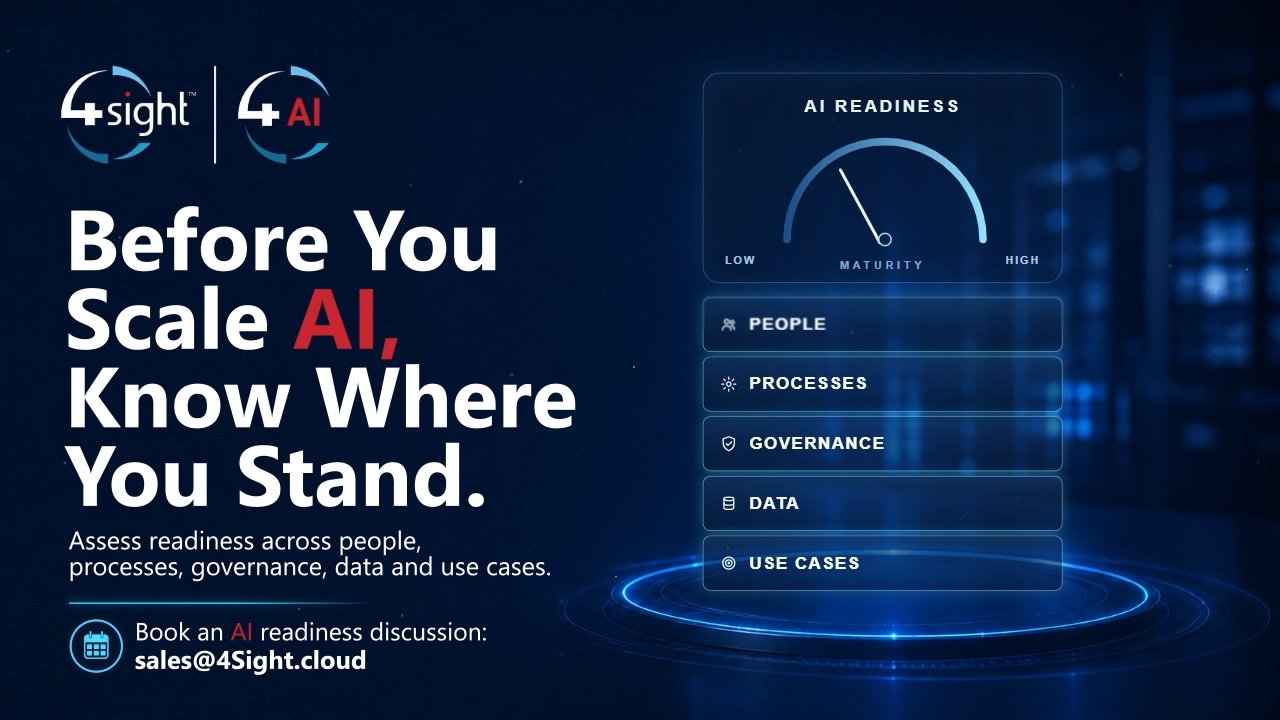
This is exactly why we built the 4Sight AI Maturity Assessment - to give organisations an honest, structured view of where they stand before they commit to scaling anything further.
It looks across five areas that determine whether AI adoption holds up under real use:
People - do employees actually have the skills, awareness and support to use AI well?
Processes - are there clearly defined places where AI creates measurable value, not just novelty?
Governance - is ownership clear? Are policies, risk controls and responsible-use principles actually in place, not just written down somewhere?
Data - is the data behind all this accessible, trusted and properly governed?
Use cases - have the achievable opportunities actually been identified and prioritised, or is the organisation just reacting to whatever's trending?
The point isn't to produce a score and move on. It's to replace assumption with an honest baseline - so leaders can see, clearly, where they're ready, where the gaps sit, and what needs to happen next.
From assessment to a roadmap that actually holds
Done properly, the assessment becomes the foundation for a real conversation: which opportunities deserve priority, where Copilot genuinely delivers value versus where it doesn't, what has to be fixed before scaling further, which teams should be activated first, what governance and data protection actually need to look like, and how progress gets measured going forward.
From there, we help build a roadmap with immediate actions, medium-term priorities, and the foundations required to scale responsibly - not just quickly.
Building adoption with confidence, not assumption
AI adoption was never meant to start and stop at deployment. It needs clarity, readiness, real employee activation, and enablement that continues well past go-live.
At 4Sight, that's the work - helping organisations understand where they actually stand today, clarify where Copilot and other AI capabilities genuinely fit, identify the use cases that matter, and build a path towards adoption that holds up over time. We combine strategic guidance with hands-on activation and maturity assessment, because turning AI interest into measurable business progress takes both.
Start with the 4Sight AI Maturity Assessment
Before you scale, know where you're standing. The 4Sight AI Maturity Assessment helps you understand your current readiness, identify the gaps across people, processes, governance, data and use cases, and prioritise the actions that build the strongest foundation for what comes next.
